

' d='M0 0h21v15H0z'/%3E%3Cpath d='M0 0h21v1H0V0zm0 2h21v1H0V2zm0 2h21v1H0V4zm0 2h21v1H0V6zm0 2h21v1H0V8zm0 2h21v1H0v-1zm0 2h21v1H0v-1zm0 2h21v1H0v-1z' fill='url(%23b)'/%3E%3Cpath fill='url(%23c)' d='M0 0h9v7H0z'/%3E%3Cpath d='M1.5 2a.5.5 0 110-1 .5.5 0 010 1zm2 0a.5.5 0 110-1 .5.5 0 010 1zm2 0a.5.5 0 110-1 .5.5 0 010 1zm2 0a.5.5 0 110-1 .5.5 0 010 1zm-5 1a.5.5 0 110-1 .5.5 0 010 1zm2 0a.5.5 0 110-1 .5.5 0 010 1zm2 0a.5.5 0 110-1 .5.5 0 010 1zm1 1a.5.5 0 110-1 .5.5 0 010 1zm-2 0a.5.5 0 110-1 .5.5 0 010 1zm-2 0a.5.5 0 110-1 .5.5 0 010 1zm-2 0a.5.5 0 110-1 .5.5 0 010 1zm1 1a.5.5 0 110-1 .5.5 0 010 1zm2 0a.5.5 0 110-1 .5.5 0 010 1zm2 0a.5.5 0 110-1 .5.5 0 010 1zm1 1a.5.5 0 110-1 .5.5 0 010 1zm-2 0a.5.5 0 110-1 .5.5 0 010 1zm-2 0a.5.5 0 110-1 .5.5 0 010 1zm-2 0a.5.5 0 110-1 .5.5 0 010 1z' fill='url(%23a)'/%3E%3C/g%3E%3C/svg%3E)
' d='M0 0h21v15H0z'/%3E%3Cpath fill='url(%23b)' d='M0 0h21v3H0zm0 12h21v3H0z'/%3E%3Cpath fill='url(%23a)' d='M0 3h21v9H0z'/%3E%3Cpath fill='url(%23c)' d='M0 5h21v5H0z'/%3E%3C/g%3E%3C/svg%3E)
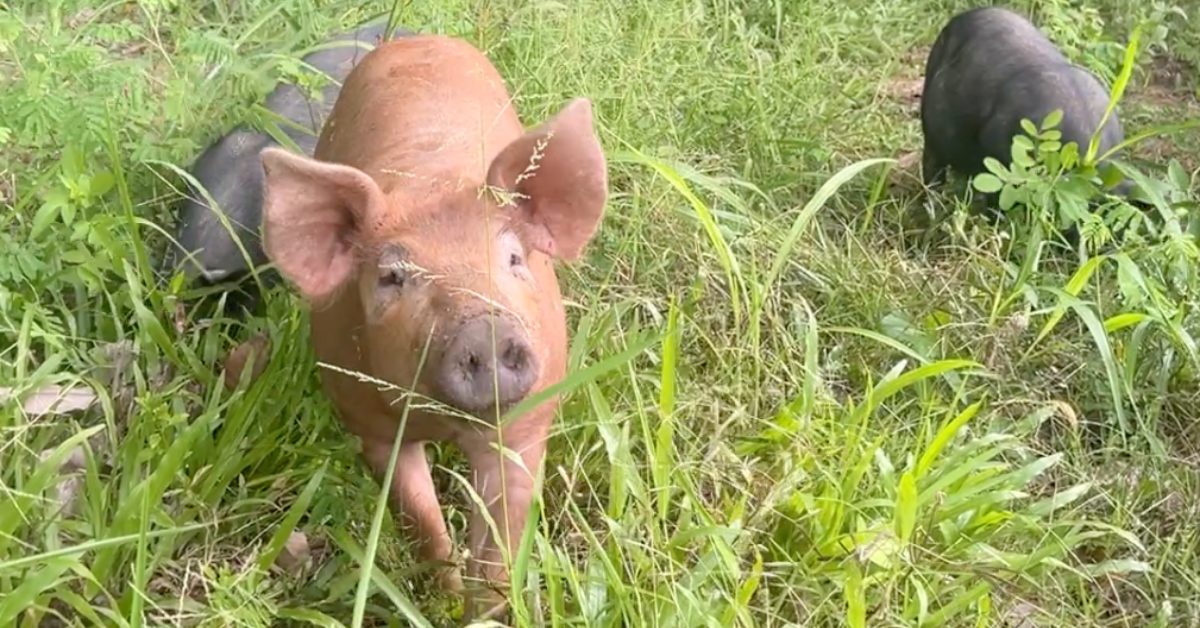
Most people picture a pig farm and think of mud, smell, and crowded pens. What they don’t picture is a herd of happy pigs rooting through the forest floor, snuffling through fallen leaves, munching on wild vegetation, and moving to a fresh patch of land every ten days.
That’s exactly how we raise our pigs at Farm Daddeaw — and once you understand the system, it’s hard to imagine raising pigs any other way. And it’s even harder to eat any other pork.
A Herd on the Move
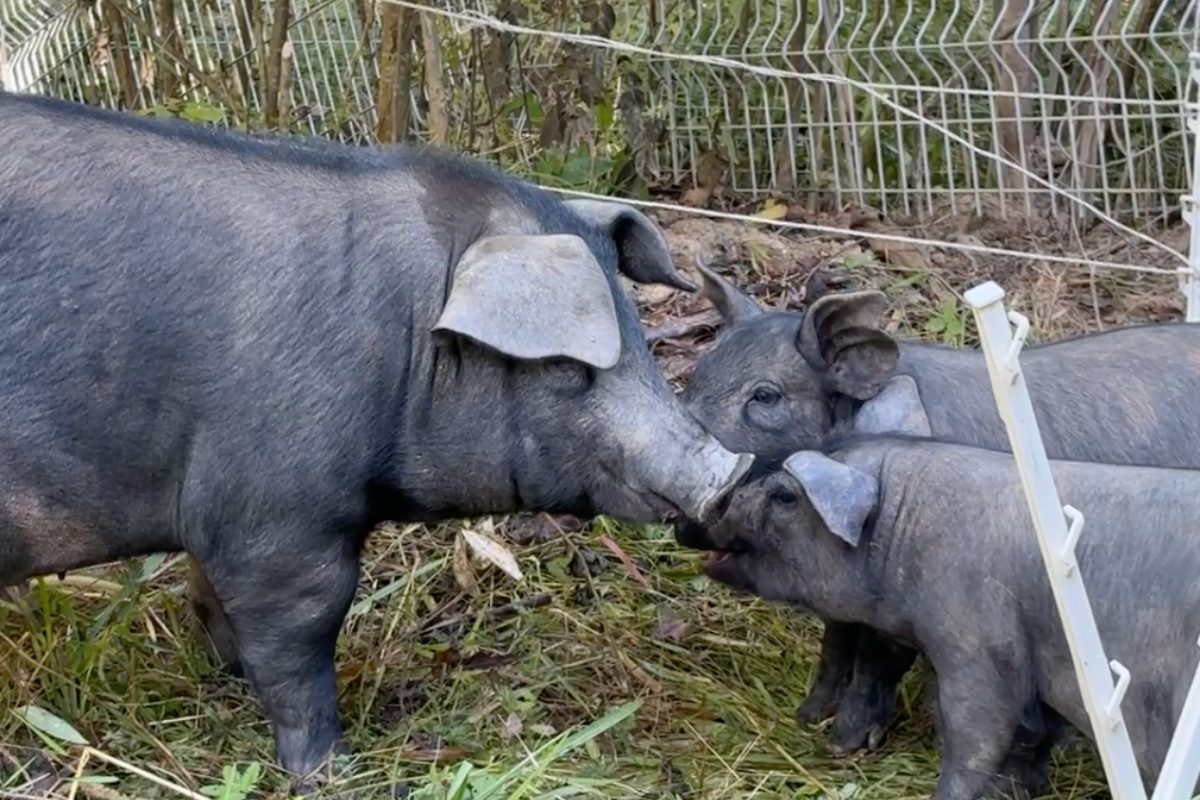
Our herd is currently around 30 pigs and growing quickly. They range across different ages, and we keep all of them together as one group — a natural, mixed-age social structure that mirrors how pigs actually live in the wild.
The cornerstone of our system is movement. Every seven to ten days, we move the entire herd to a fresh section of forest. Each pig gets a minimum of 40 square metres of new vegetation — room to roam, root, and truly express their natural behaviours. We call this forest-raised pork, because that’s exactly what it is: pork raised in, and by, the forest.
What happens to the patch they leave behind? Within a week, the pigs have eaten virtually everything. The grasses, shrubs, bugs, roots, fallen fruit — gone. It sounds dramatic, but it’s actually one of the most elegant things about this system. Nature handles the cleanup, and the land gets a long, undisturbed rest before the pigs return.
What They Actually Eat
The forest provides a remarkably diverse buffet. Pigs are omnivores, and in a forest setting they get exactly what their biology calls for: fresh vegetation, insects, roots, and grubs — a rotating, seasonal menu that commercial farming can never replicate.
Their main diet is supplemented with our organic feed — the same high-quality, certified organic ingredients we use for our chickens. No growth hormones. No chemical additives. Just clean, certified organic feed topped up by whatever the forest provides that day.
But the forest foraging is where the real nutritional magic happens. A diverse diet means diverse nutrition, and that diversity translates directly into the depth of flavour in the meat. This is one of the key reasons our organic pork in Thailand tastes so different from anything you’d find in a supermarket.
More Space Than You Can Imagine
Let’s put the numbers in perspective.
A pig in a conventional farming operation typically spends its entire life in a concrete pen with less than 2 square metres of space. Our pigs get 40 square metres of fresh forest per move — 20 times more space, and it’s always new.
By the time a pig reaches six months old — spending its first two months in the nursery pen and the rest in the forest — it will have made at least 12 moves. That means each pig has access to a minimum of 480 square metres of new forest area over its lifetime. Nearly half a rai of untouched forest floor, just for one pig.
That’s not a minor improvement. That’s a fundamentally different life.
Pigs Are Cleaner Than You Think
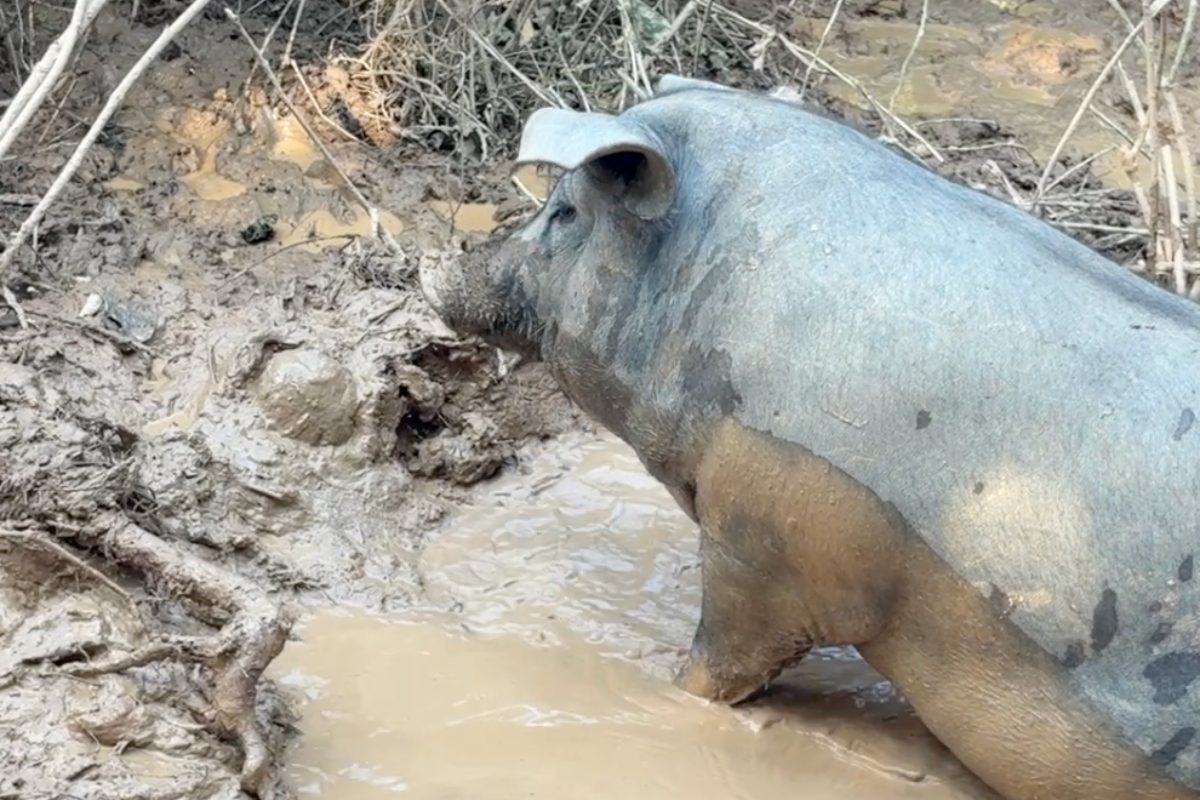
Here’s something most people don’t know: pigs are actually very clean animals.
In a natural setting, pigs instinctively keep their sleeping areas and their toilet areas completely separate. They are fastidiously tidy about this. The image of the filthy, chaotic pig is really a product of industrial confinement — when you pack animals into a space with nowhere to go, cleanliness becomes impossible.
Our pigs look muddy, and they are — but for a very good reason. Pigs cannot sweat. They have no sweat glands, so rolling in mud is their natural cooling system. It keeps their body temperature down, protects them from insects, and acts as a natural sunscreen. The mud is not a sign of dirty living — it’s a sign of healthy, self-regulating animals doing exactly what they’re supposed to do.
When they move to fresh forest, they leave the old mud wallow behind. Clean ground, clean air, clean start.
How We Actually Move Them: The Logistics
Moving a herd of pigs through the forest every ten days sounds complicated. In practice, it’s a well-rehearsed routine that takes about an hour.
We use a portable electric fence — a lightweight, moveable system that defines the pigs’ grazing area and keeps them safe. Our model is inspired by Joel Salatin’s work at Polyface Farm in Virginia, USA — one of the most respected regenerative farming operations in the world. Salatin’s approach to rotational grazing with portable fencing has been refined over decades, and we’ve adapted it for our tropical forest setting in Nan.
The process each move:
- Clear the new area — we walk the new section first, cutting back any thick vegetation that would prevent the fence from making proper ground contact. This takes most of the hour.
- Install the portable electric fence — lightweight posts and a double electrified wire that the pigs learn to respect very quickly.
- Move the water — that’s it. The pigs walk into their new space and immediately get to work.
Within minutes of arriving in a fresh patch, the rooting begins. It’s one of the most satisfying things to watch on the farm — animals doing exactly what they evolved to do, with joy and purpose.
Why This Makes Better Pork
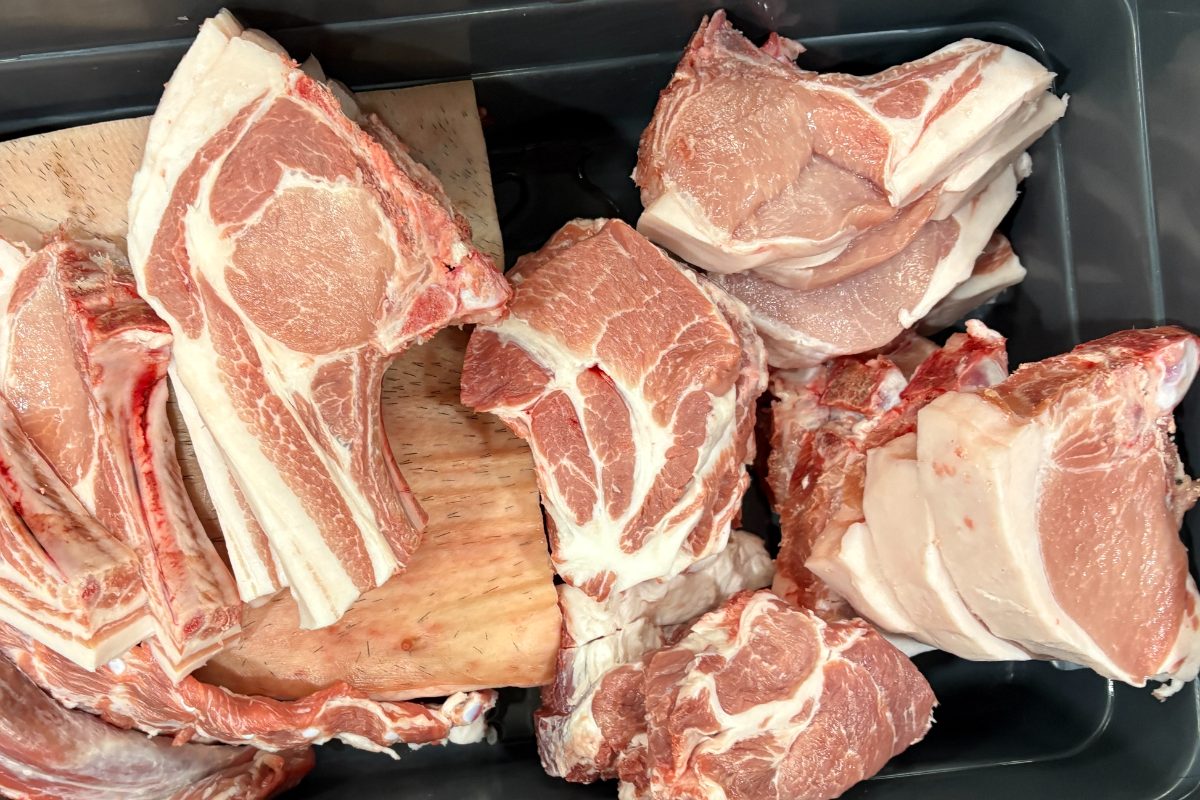
Everything about this system — the movement, the space, the diverse diet, the forest environment — produces antibiotic-free, chemical-free pork that tastes fundamentally different from what you find in a supermarket.
Muscle structure: Pigs that roam and root develop strong, well-exercised muscles. This creates a firmer texture and a more complex, satisfying bite — the opposite of the soft, watery meat that comes from confined animals.
Fat quality: A diverse, natural diet produces fat with a richer flavour profile and a better fatty acid composition. Our pigs’ fat has a natural golden hue and a depth of flavour that renders beautifully in cooking.
No stress: Pigs raised in confinement live in a state of chronic stress, which floods the meat with cortisol and affects texture and taste. Our pigs’ lives are calm, social, and stimulating. That peace shows up on the plate.
No shortcuts: No antibiotics, no growth hormones, no vaccines. Just pasture-raised pigs in the forests of northern Thailand, living as pigs should, growing at their natural pace.
A System That Gives Back
One final thing worth saying: this isn’t just good for the pigs and good for your plate. It’s good for the land.
The pigs’ rooting aerates the soil. Their manure fertilises it. Their grazing and browsing opens up the forest floor to light and new growth. By the time we bring them back to a previously grazed section — months later — the vegetation has regrown, the soil is richer, and the cycle continues.
This is what regenerative farming actually looks like in practice. Not just taking from the land, but giving back to it with every rotation.
Where to Buy Our Organic Pork in Thailand
If you’re looking for truly clean, antibiotic-free pork in Thailand — raised without chemicals, without confinement, and without compromise — this is it. Our forest-raised pork is available for order via Line and delivered directly to your door.
Order via Line: @farmdaddeaw
If you want to know more about our organic feed, visit our Organic Feed page. And if you have questions about anything — the pigs, the system, the farm — we always welcome them.
Want to learn more about how we raise all our animals? Explore our How We Farm page for the full picture.